


The 2026 FIFA world cup has arrived, introducing multiple changes to the tournament’s format like a 3 country hosting tandem and an expanded 48 team field. The most controversial of the changes is the inclusion of mandatory hydration breaks, stoppages around the mid-points of each half to prioritize the safety of players during a hot North American summer.
In a release last December, FIFA made their perspective on the new rule clear, stating “Players at the FIFA World Cup 2026™ will benefit from three-minute hydration breaks in each half of games as FIFA prioritises player welfare throughout next summer’s tournament co-hosted by Canada, Mexico and the United States.” Unlike previous World Cups where the breaks were decided by match conditions, these breaks now happen in every match.
Many fans of the sport are unhappy with this change, arguing that the stoppages upset the continuity and integrity of the game. One topic that often comes up is momentum:
that's why hydration breaks are so bad -- breaking a team's momentum in football is an unforgivable sin. https://t.co/Sg6UJI033a
— ST (@seyitaylor) June 15, 2026
Match Momentum
Fortunately, this is dispute can be settled with some data! A new metric that has been introduced to soccer in recent years is match momentum, which quantifies the previously intangible sense that a team is "on a roll" or "headed towards a goal". As described in this article by theanalyst.com, match momentum considers the percentage of touches, passes, and shots that a team has in a given period of time, weighted by their threat level (the likelihood that they result in a goal being scored).
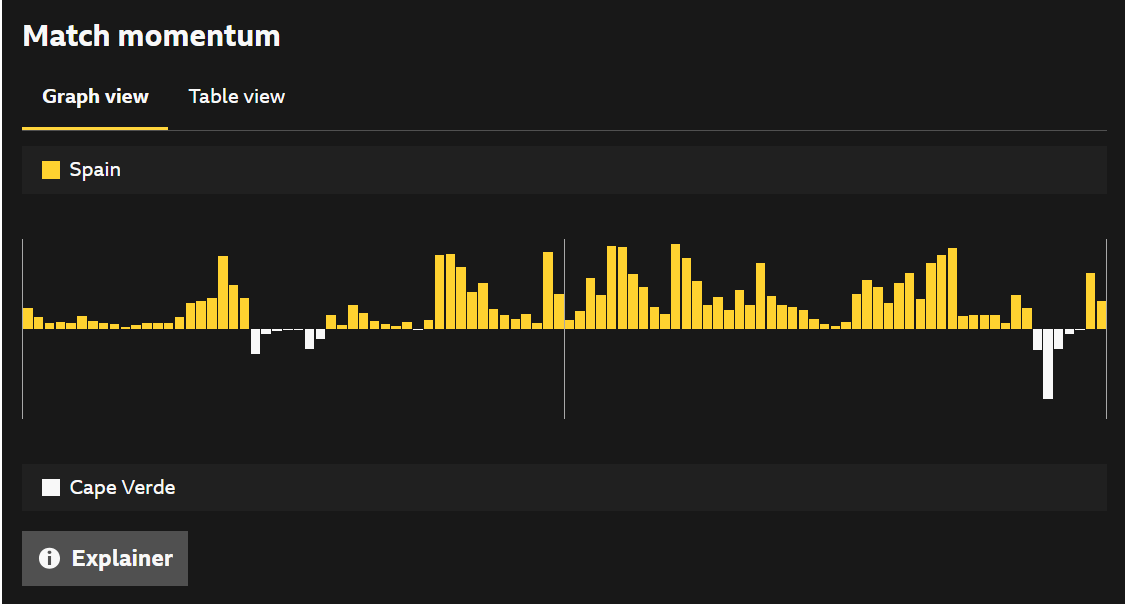
This data is available from various statistical providers, most visibly from the BBC, which includes a match momentum plot on its match summary page.
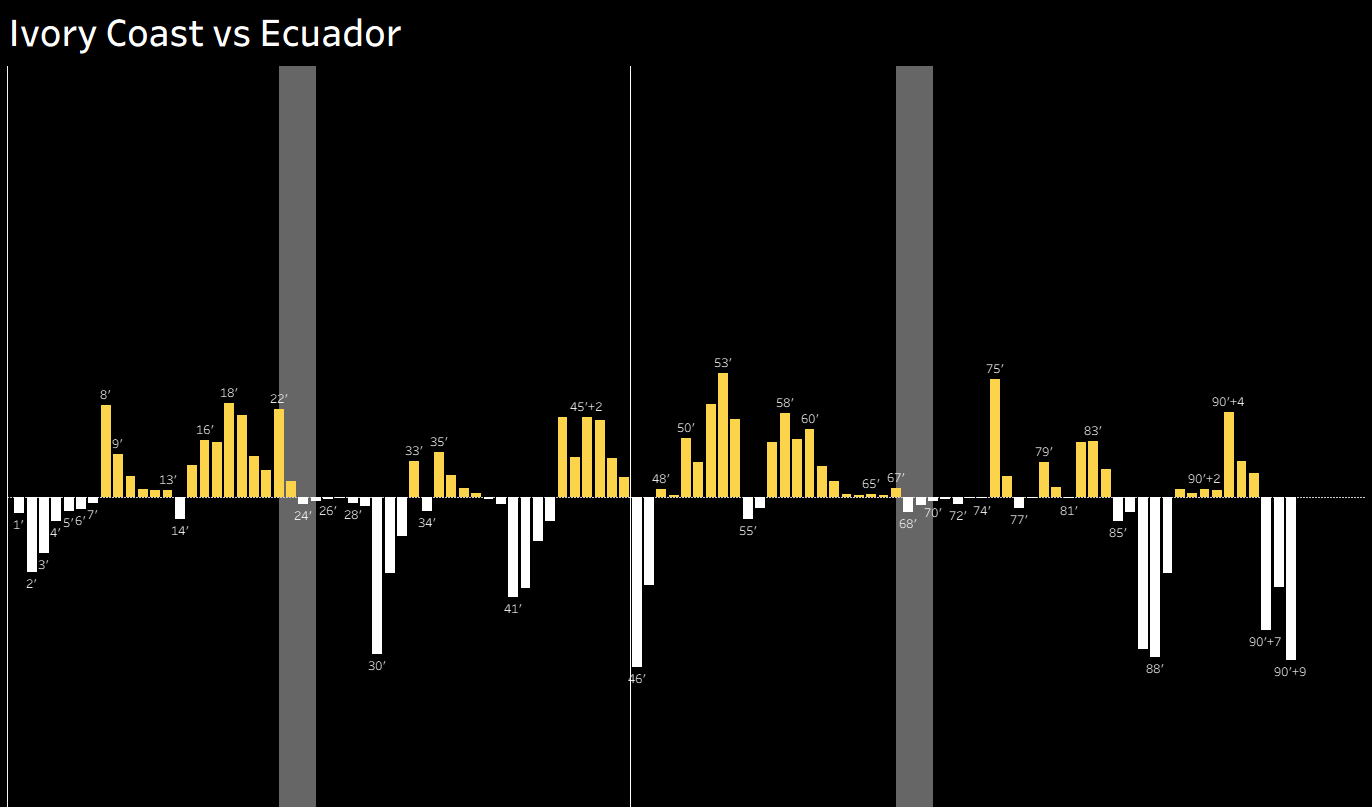
Digging into the data, some instances of momentum changes seem to crop up. For example, the first hydration break in the Ivory Coast vs. Ecuador game seemed to completely flip the script, reducing Ivory Coast's momentum from consistently positive levels down to zero, before Ecuador took over with their best chance of the half soon after the break.
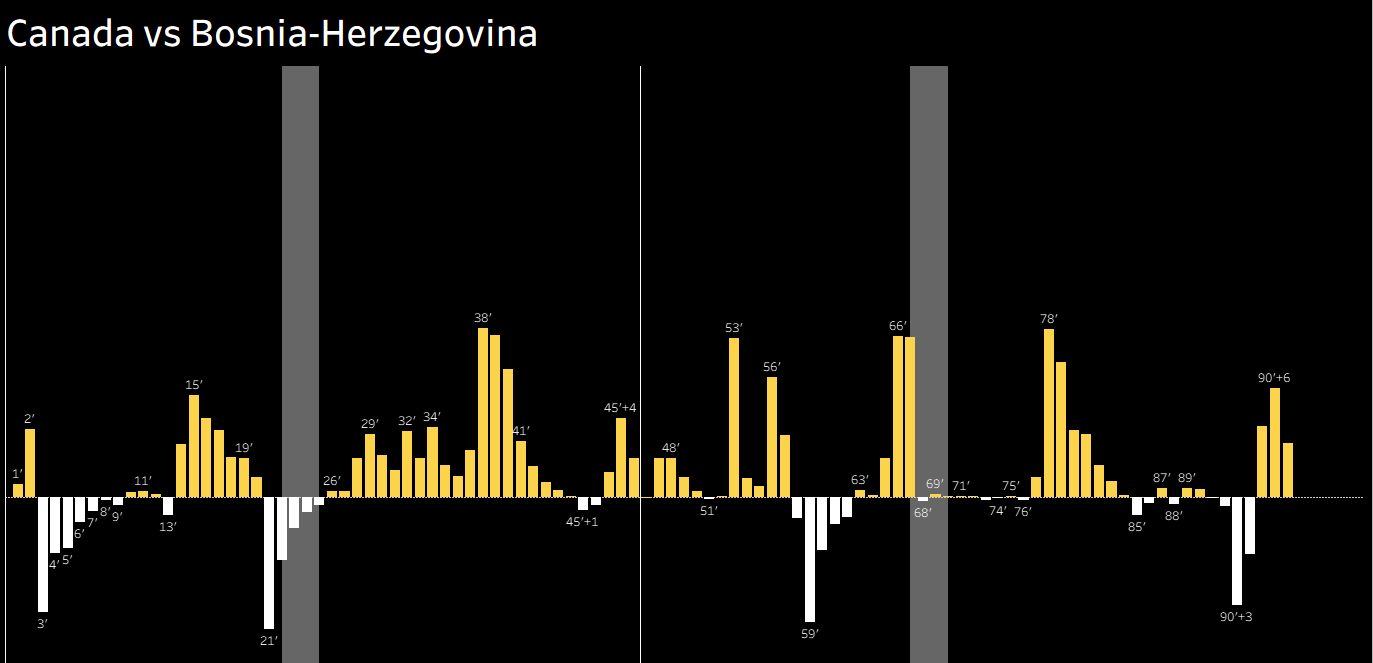
Fans came to the same conclusion in regards to the Canada vs. Bosnia and Herzegovina game, where the first hydration break flipped the momentum to Canada's side while the second seemed to eliminate any momentum in the game altogether.
Does the Claim Hold Up?
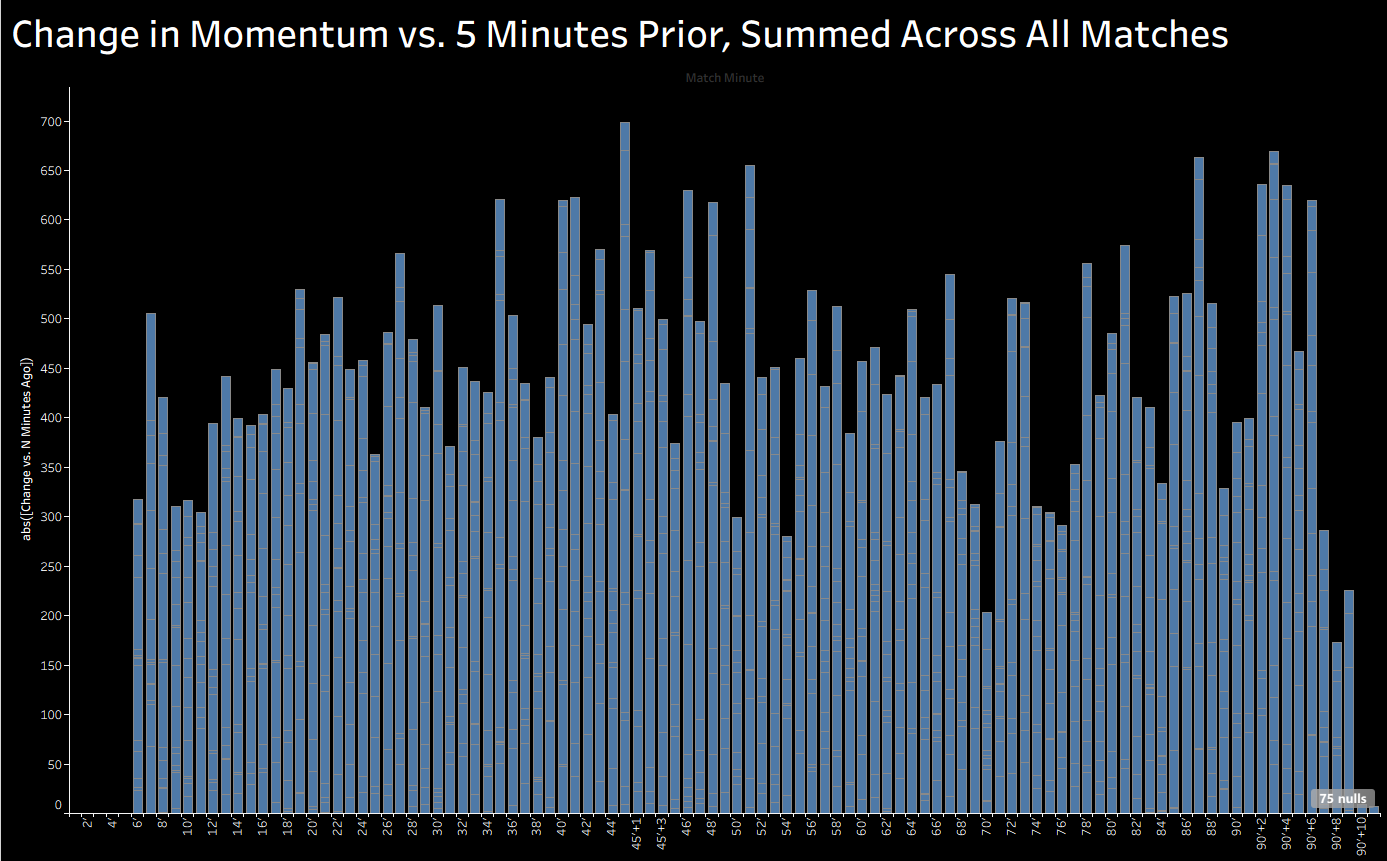
If we want to validate the claim that the hydration breaks are artificially "changing the momentum", we need to come up with a way to quantify it. Let's remodel the phrase "changing the momentum" to "causing large changes in momentum after the break compared to before the break" – something we can calculate! The metric in focus be the magnitude (absolute value) of the difference in momentum at a given minute of the match compared to the momentum 5 minutes before that. This way, if there is a major change in a 5 minute span, we would expect to see large magnitudes, and if momentum largely stays the same we would expect to see small magnitudes.
To help visualize this, I put the new metric next to the original plot for the Canada vs Bosnia and Herzegovina game. At moments of drastic change, such as the switch from positive to negative momentum at 21 minutes, there are the largest peaks in the metric, while moments of stability like 29' to 34' and 69' to 76' have very low values of the metric.
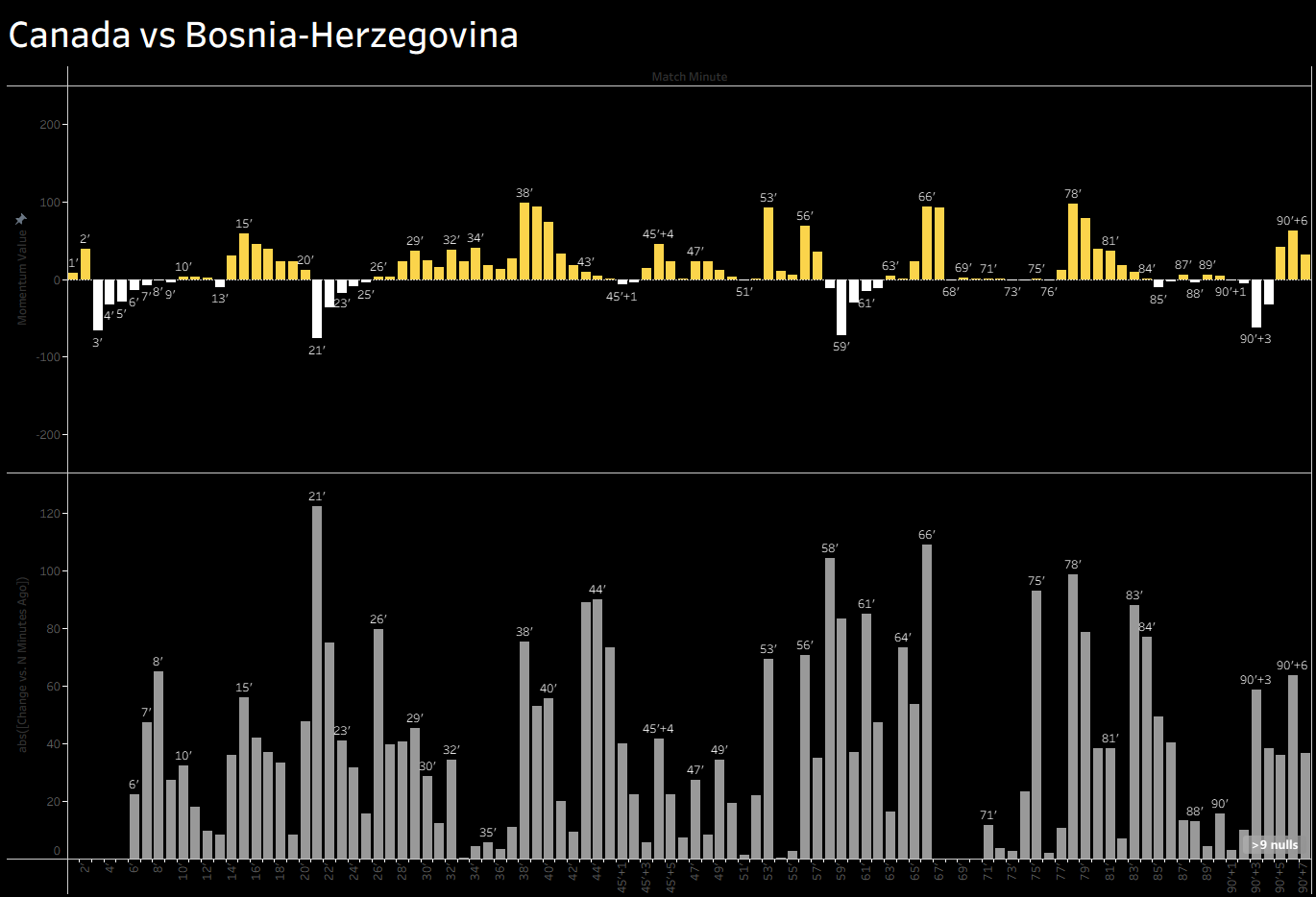
In theory, adding up these plots across all of the games (or at least the 10 that have been contested thus far) should reveal the minutes that are most prone to drastic changes in momentum.
The result is ... not very striking (soccer pun intended). If the hydration breaks really had a major effect, we would expect big spikes in total momentum change around 27' to 32' and 72' to 77', 5 minutes after the respective hydration breaks. This is not only the case for 5 minute gaps – I extended my analysis to all possible lags from 1 minute to 10 minutes, coming up with a similar result every time.
Other Theories
So if momentum is not being systematically affected, what is causing the outrage among fans? One possibility is human bias in data interpretation. Although our eyes may be drawn to the changes in momentum around the bands I've highlighted, there are tons of variations throughout the matches – we just give more weight to what we are drawn to look at and care about. This is often the value of statistics and data visualization in general, to remove the emotional and psychological elements of data interpretation and distill down to indisputable facts.
Another theory I have is that the hydration breaks are serving as tactical opportunities for teams. In a sport where there are no timeouts and usually only one chance to regroup and talk strategy (at halftime) the hydration breaks have given teams two additional chances to meet and adjust their approach to the game.
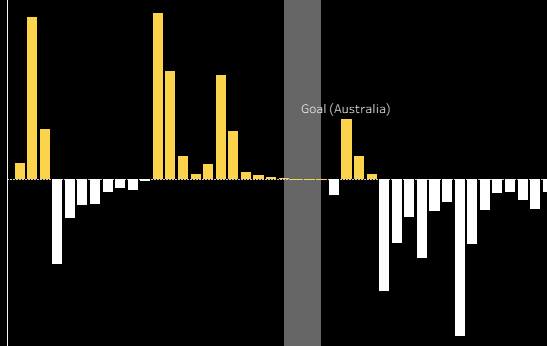
In the Australia vs. Turkey game, Australia managed to score right after their first hydration break,
and Brazil found a way to score a goal coming out of a hydration break in the direct aftermath of conceding to Morocco.
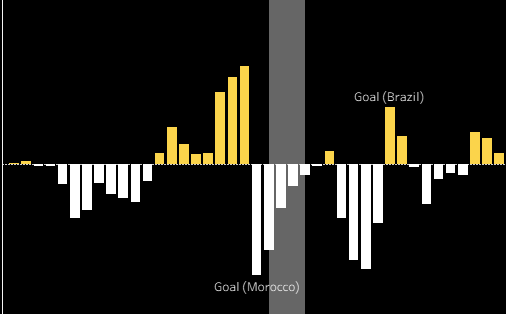
Tactical advantage and goalscoring is highly correlated with momentum, and may feel like momentum in the moment, but they are two separate metrics (which might explain the lack of correlation visibly present in momentum data, despite the feeling being so strong).
In the end, maybe it is the coaches rather than the players who are changing the landscape of the game during hydration breaks. Only time will tell if this trend persists throughout the rest of the group stage and into the knockout stage of the World Cup.