


We've never had more data, and it's never been so affordable to store it. So why is managing it still such a challenge?
Today data is store in three main ways Data Lake, Data Warehouses and clouds, each is dependent on the other and essential in letting a business successfully...
As organizations generate increasingly large volumes of information, the technologies used to store and manage that data have had to evolve. Before, companies rely heavily on on-premises infrastructure, purchasing and maintaining their own servers and databases. This required substantial investment in hardware, maintenance, and capacity planning.
Today, businesses can store enormous quantities of information without owning the physical infrastructure. More importantly, they can choose different technologies depending on how that information needs to be accessed, processed, and analyzed.
This has led to the widespread adoption of three important concepts in modern data architecture:
- Data warehouses: Designed to organize and analyze structured business information.
- Data lakes: Designed to accommodate large volumes of data in different formats.
- Cloud storage: Infrastructure that enables organizations to store information remotely and scale capacity as needed.
Why Does Data Storage Architecture Matter?
How an organization stores and manages its information directly influences how efficiently it can operate, make decisions, and respond to changing business requirements.
Here are some of the key considerations made when designing a data architecture:
- Accessibility: How easily can employees, applications, and analytical tools retrieve the information they need?
- Scalability: Can the organization's infrastructure accommodate growing data volumes without requiring significant redesign?
- Cost: What does it cost to store, process, retrieve, and transfer information?
- Data integrity and governance: How can the organization ensure information remains accurate, consistent, secure, and accessible only to authorized users?
- Performance: Can analytical queries and operational workloads run efficiently as the volume of information increases?
A system designed to process structured business reports efficiently might not be the most practical environment for storing millions of images or unprocessed application logs.
Similarly, an inexpensive storage repository might accommodate enormous quantities of information without providing the performance or structure necessary for business intelligence.
When Is Structured Storage Important?
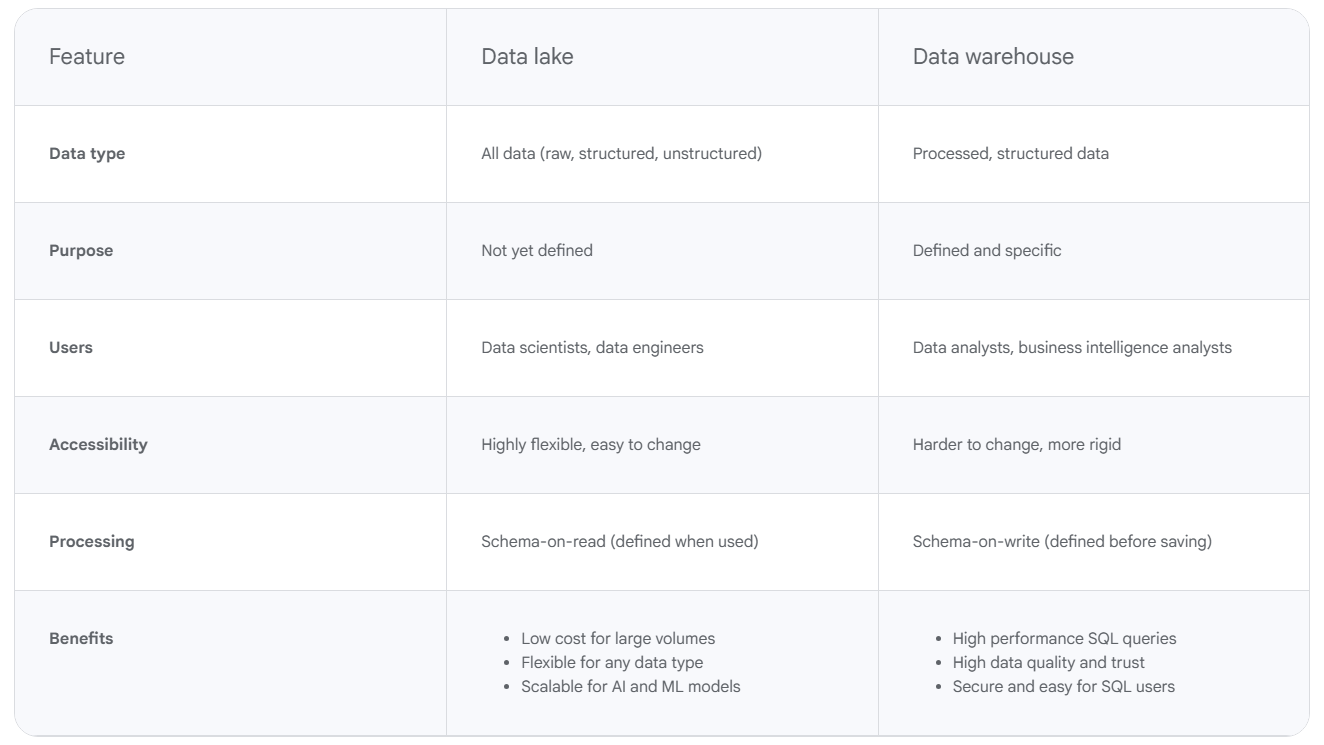
A data warehouse is a centralized analytical system used to consolidate, organize, and query information from multiple sources.
Its primary purpose is to make data reliable and accessible for reporting, business intelligence, and decision-making. Here data is typically cleaned, standardized, and organized into structured tables before being made available for business analysis.
When are data warehouses used?
Data warehouses are particularly useful when an organization needs:
- Consistent reporting and business intelligence across multiple departments.
- Structured information that analysts can query using SQL.
- Historical analysis of business performance.
- Standardized definitions for their data.
- Reliable datasets for dashboards and other analytical applications.
For example, finance, sales, and operations teams may depend on a shared analytical environment to ensure they're working with consistent business metrics.
What are the limitations?
Although warehouses are highly effective for structured analytics, they aren't necessarily the most economical or flexible destination for every type of information.
Large volumes of raw logs, images, and other unstructured files may be better retained in a different storage environment. Additionally, processing complex transformations and queries can become expensive, particularly when computational resources aren't managed efficiently.
This raises an important question: What if an organization wants to retain data before it knows exactly how that information will be used?
4. Data Lakes: When Is Flexibility More Important Than Structure?
A data lake is a storage architecture designed to accommodate large volumes of structured, semi-structured, and unstructured information.
Unlike a conventional analytical warehouse, a data lake doesn't require all incoming information to conform to a predefined business model before it can be stored. Data can be retained in its original format and processed later when a particular analytical requirement emerges. Structure can be applied when information is accessed, rather than requiring every dataset to be modeled before storage.
When are data lakes used?
Data lakes are particularly valuable when organizations need to:
- Retain large quantities of historical information economically.
- Accommodate different data formats, including CSV, JSON, images, and documents.
- Preserve raw source data for future analysis.
- Support exploratory analytics, data science, and machine learning.
- Process information whose future applications aren't yet fully understood.
Their flexibility allows organizations to collect and preserve information without immediately committing to one analytical structure.
What are the limitations?
The flexibility of a data lake can also become its greatest weakness.
Without effective documentation, metadata management, quality controls, and governance, a data lake can become difficult to navigate.
This is sometimes referred to as a data swamp, where vast amounts of information have been accumulated but are difficult to locate, interpret, or trust.
A data lake therefore requires more than inexpensive storage. It needs systems and processes that make its contents manageable and useful.
5. Cloud Storage: Where Does the Infrastructure Fit?
Cloud storage differs from data lakes and data warehouses in an important way.
While lakes and warehouses describe approaches to managing information, cloud storage provides infrastructure for physically storing it. Cloud providers maintain the underlying hardware and make storage capacity available to organizations over a network. This removes the need for businesses to purchase and maintain all their own storage equipment. Popular examples include Amazon S3, Google Cloud Storage, and Microsoft Azure Blob Storage.
When is cloud storage used?
Cloud storage is useful when organizations require:
- Scalable storage capacity without purchasing additional physical hardware.
- Remote access to information and integration with cloud applications.
- Flexible storage options for different data formats and access patterns.
- Backup, archival, and disaster recovery capabilities.
One of its major advantages is the separation of storage from compute. Instead of requiring storage capacity and processing power to scale together, organizations can use separate resources for each.
This is particularly valuable for analytical workloads where large datasets may be stored continuously but processed only periodically.
Is cloud storage always cheaper?
Cloud object storage can be inexpensive, especially for large volumes of infrequently accessed information. However, organizations also need to consider data retrieval, network transfers, storage operations, and processing costs.
For example, retaining a large historical dataset may be relatively affordable, while repeatedly transferring and transforming the entire dataset could be considerably more expensive.
This distinction has become increasingly important as businesses move toward cloud-based data architectures.
6. How Do Data Warehouses, Data Lakes, and Cloud Storage Work Together?
Although these technologies address different requirements, they can form part of the same organizational data architecture.
Let's consider an airline that collects flight performance records, passenger bookings, maintenance reports, and customer feedback.
The airline wants to preserve its historical information while also providing reliable reporting to operational and management teams.
Cloud storage provides the infrastructure.
The airline uses Amazon S3 to store large quantities of information without maintaining its own physical storage servers.
A data lake then retains diverse information.
The airline establishes a data lake using its cloud storage environment. Flight records, maintenance documents, and other source files are retained in their original formats, alongside any cleaned or processed datasets.
This preserves flexibility for future analytics, investigations, and machine learning projects.
Then a data warehouse supports business intelligence.
Relevant information is cleaned, standardized, and loaded into a platform such as Snowflake. Within the warehouse, flight performance data can be organized into fact and dimension tables. Analysts can then query these tables and connect them to Tableau dashboards to monitor airline performance.
Is this better than relying on one system?
Using these technologies together can provide several advantages.
- Greater flexibility: The organization can preserve raw information without requiring every dataset to be immediately prepared for reporting.
- Improved analytical performance: Frequently queried business information can be kept in dedicated analytical environment.
- Better resource allocation: Large volumes of historical data can remain in relatively inexpensive object storage, while more costly processing resources are used where needed.
- Future adaptability: Raw historical records can be reused for new analytical applications without necessarily reconstructing the original source data.
However, introducing multiple systems isn't always the best choice.
Maintaining separate data lakes and warehouses can involve additional pipelines, duplicated datasets, governance complexity, and operational costs. For smaller organizations or simpler analytical requirements, a single well-designed cloud data warehouse may be entirely sufficient.
The objective should therefore be to select an architecture based on actual business needs, rather than adopting additional technologies simply because they're available.